
Bar-Turned Parts for Electrical Connectors
How OEM buyers should specify bar-turned brass connector and terminal parts, including drawings, contact zones, finish, mating fit, and sample approval.
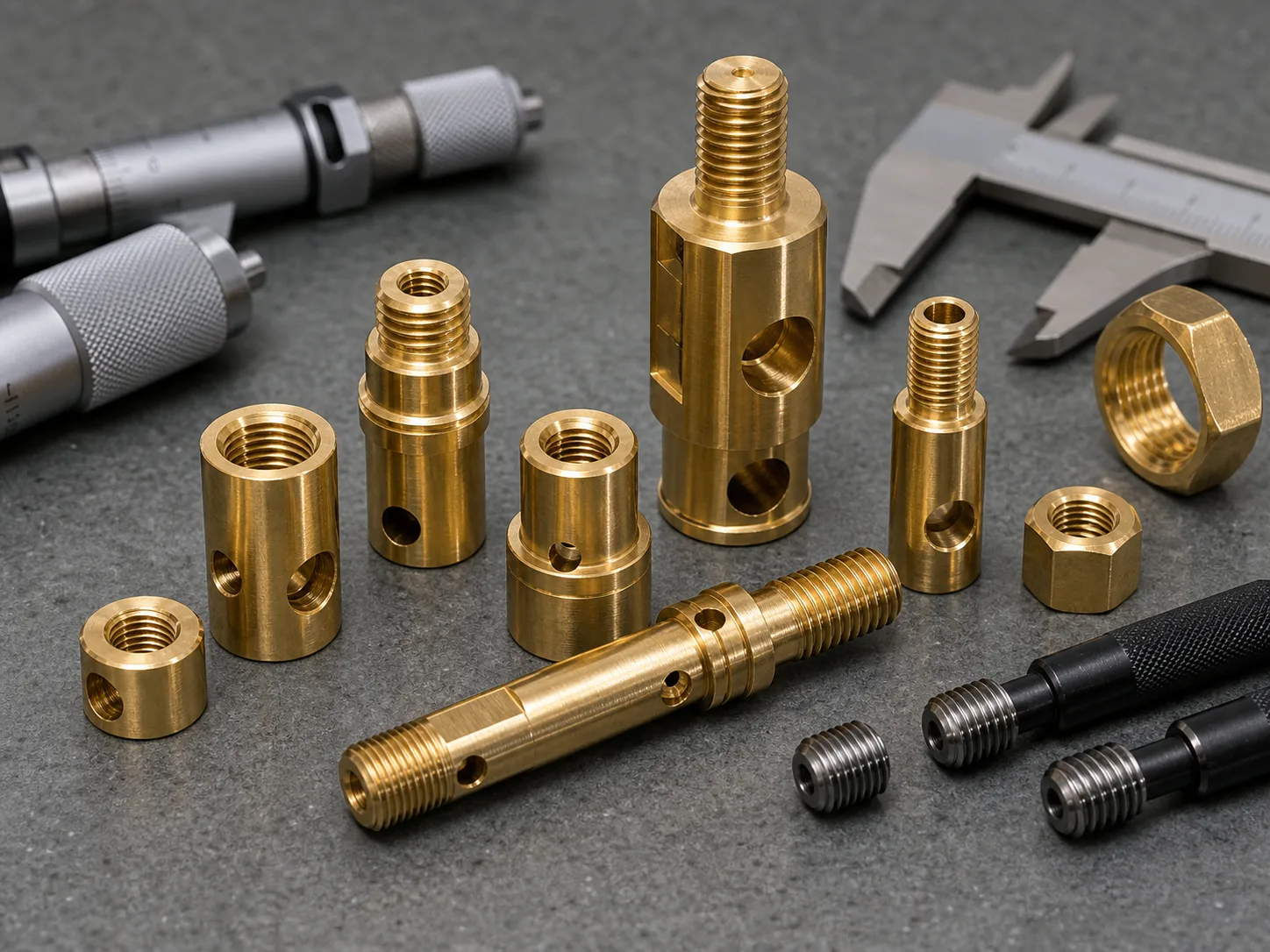
Bar-turned parts for electrical connectors should not be sourced as generic lathe parts. In an OEM terminal or connector project, a small turned brass sleeve, pin, socket, collar, threaded body, or terminal post can control mating fit, contact surface, insulation clearance, plating quality, and repeat assembly.
Our view is simple: a turned connector part should be quoted around its function in the assembly, not around the machining process alone. A low unit price is not useful if the thread binds, the contact zone is unclear, plating reaches the wrong surface, or the sample cannot be released into repeat production.
That is why the RFQ should not only ask for a “turned brass part.” It should explain what the part does in the finished connector or terminal assembly, which surfaces touch the mating part, which features are threaded or bored, which zones will be plated, and how the sample will be approved before repeat production.
This guide explains how to prepare a drawing-based RFQ for bar-turned electrical connector parts without turning the request into a broad catalog connector search.
Axiterm’s Supplier Judgment: What We Would Check First
For OEM sourcing, we would not start by asking whether the part can be turned. Most simple round brass parts can be machined by many suppliers. The safer question is whether the supplier understands the interface the part must survive after machining, plating, assembly, packing, and repeat ordering.
Before treating a bar-turned connector part as ready for quotation, check these points first:
- Function before shape. A sleeve, socket, or threaded post may look like a simple cylinder, but its real risk is usually mating fit, contact surface, shoulder location, or assembly stack.
- Contact zone before finish name. “Gold plated,” “nickel plated,” or “tin plated” is not enough. The RFQ should show which surfaces are functional contact zones, visible appearance zones, protected threaded zones, and noncritical areas.
- Mating hardware before thread price. Thread standard, engagement length, matching nut or screw, panel thickness, and assembly direction should be reviewed together.
- Sample release before repeat orders. If the approved drawing, sample, inspection points, finish notes, and packaging rules are separated, repeat orders can drift even when the part still looks correct.
- Scope before supplier selection. If the buyer needs a certified PCB, RF, automotive, or complete catalog connector system, that should be confirmed before asking a terminal-component supplier to quote a subcomponent.
Do not decide by price, appearance, or the keyword “bar turned” alone. For connector and terminal components, the useful supplier is the one that asks for the drawing, mating interface, finish zones, and approval basis before locking the quotation.
What Counts as a Bar-Turned Connector Part?
In this context, bar-turned parts are small machined components made from bar stock and reviewed from a drawing, sample, or equipment interface. They may be used inside a connector, terminal, binding post, panel interface, or hardware set.
Common examples include:
- Threaded terminal bodies and posts.
- Brass connector pins, sockets, sleeves, and collars.
- Panel-mount bushings, spacers, retaining nuts, and shoulder parts.
- Machined bodies used with molded insulation or washer stacks.
- Small contact or hardware parts that require plating review.
- Drawing-based brass or copper terminal components used in a larger OEM assembly.
Axiterm’s strongest fit is not broad catalog connector supply. The fit is drawing-based terminal and connector components where the buyer needs machining review, mating fit review, surface finish planning, sample approval, and repeat-order control.
Which Requests Fit Axiterm’s Review Scope?
Use this table before sending an RFQ.
| Request Type | Fit for Axiterm Review | What to Confirm |
|---|---|---|
| Turned brass terminal body from a drawing | Good fit | Thread, bore, shoulder, contact area, finish zones, mating hardware |
| Brass connector pin, socket, sleeve, or collar | Good fit when it belongs to terminal or connector component scope | Mating part, insertion fit, contact zone, plating expectation, burr-sensitive edges |
| Binding-post-related threaded brass hardware | Good fit | Panel stack, insulation, nut/washer fit, front/rear interface |
| Replacement of an existing turned connector component | Good fit if approved samples and dimensions are available | Current sample, critical dimensions, known failure point, packaging reference |
| Complete catalog connector assembly | Needs review; may be outside scope | Whether Axiterm is quoting components or the entire connector product |
| PCB connector, RF connector, certified connector, or switchgear part | Hold unless only a custom terminal subcomponent is needed | Compliance requirement, product standard, and exact subcomponent drawing |
This boundary matters. It keeps the article aligned with custom terminal component manufacturing rather than unsupported connector catalog claims.
Drawing Details That Decide the Quote
A useful RFQ starts with the part geometry and the function of each feature. If a supplier quotes only from outside diameter, length, and material without asking how the part mates, where it conducts, or which surfaces need finish protection, the quote may be too thin for an OEM release decision.
Turned Diameter, Bore, Shoulder, and Length
Bar-turned connector parts often look simple until the mating feature is checked. A small shoulder may set panel spacing. A bore may accept a mating pin. A turned diameter may control socket fit. A collar may decide whether a washer stack or molded insulation seats correctly.
Send the drawing or sample with these features marked. If the part is copied from an existing supplier sample, explain which dimensions are critical and which can be adjusted during review.
Thread and Mating Hardware
Thread details should not be treated as a note at the end of the RFQ. Include the thread standard, mating nut or screw, engagement length, installation direction, panel thickness, and whether the part is repeatedly assembled or tightened.
This is where CNC machining for terminal components and brass machining become more important than a generic turned-part quote. The thread must work in the real assembly.
Contact Zone and Appearance Zone
Separate surfaces by function:
- Contact zones that touch the mating terminal, plug, lug, pin, socket, or conductor.
- Appearance zones visible after assembly.
- Threaded zones that must remain usable after finish.
- Protected zones that should not be scratched during assembly or packaging.
- Noncritical zones where cosmetic expectations can be lower.
If the RFQ only says “gold plated” or “nickel plated,” the supplier still does not know which surfaces are functional. Use the plating review path to define finish zones before sampling.
Cross Holes, Slots, Knurls, and Burr-Sensitive Edges
Small connector and terminal parts often include cross holes, cable slots, knurls, screwdriver access, wire-entry openings, or edges near contact surfaces. These features need a burr and edge expectation.
Do not assume the machining route will know which edges are sensitive. Mark the areas where burrs, scratches, or sharp edges could affect contact, insulation fit, cable entry, or assembly handling.
RFQ Inputs for Bar-Turned Electrical Connector Parts
Send a compact package through the RFQ page or email review channel:
- 2D drawing, 3D model, dimensioned sketch, or approved sample.
- Part function inside the connector, terminal, binding post, panel, or equipment assembly.
- Material requirement or functional material assumption.
- Turned diameter, bore, shoulder, thread, slot, cross-hole, knurl, or mating feature.
- Contact zones, appearance zones, protected zones, and finish expectation.
- Mating parts: plug, socket, lug, cable, wire, panel, washer, molded insulation, or housing.
- Quantity range, sample quantity, and repeat-order expectation.
- Inspection points and acceptance criteria if already defined.
- Packaging requirement if threads, finish, or visible surfaces need protection.
If any requirement depends on electrical rating, voltage, certification, safety approval, controlled tolerance, or a named test method, include that requirement separately. This article does not claim those values for Axiterm.
Common Risks Before Sampling
| Risk | Why It Happens | Prevention Before RFQ |
|---|---|---|
| The part fits the drawing but not the assembly | Mating parts, panel stack, or insulation were not supplied | Send the assembly context and mating hardware |
| Threads fail during installation | Thread standard, engagement, or matching nut was assumed | Send thread details and mating hardware |
| Contact surface is damaged or unclear | Contact zones and appearance zones were not separated | Mark surface functions before plating review |
| Burrs affect cable entry or socket fit | Cross holes, slots, and edge sensitivity were not identified | Mark burr-sensitive features and use sample approval |
| Finish approval becomes subjective | Finish type was named but visible/contact zones were not defined | Send reference sample, finish-zone notes, and packaging expectation |
| Repeat orders drift from the sample | Drawing revision, sample reference, and packing rules were separated | Keep approved drawing, sample, inspection points, and packaging together |
These risks are usually cheaper to fix before quotation than after the first sample lot.
How Bar-Turned Parts Fit with Custom Terminal Components
A turned connector part may be only one component in a larger RFQ. It may connect to a molded insulation part, a copper conductor, a binding post body, a washer stack, a screw set, a label, or a finished equipment panel.
For drawing-based projects, start with custom terminal components when the component belongs to a larger terminal interface. Start with custom brass components when the project is mainly a machined brass part. Start with binding posts when the buyer is reviewing a recognized binding-post product family.
The correct path can change after review. A simple turned sleeve may become part of an assembly RFQ if packaging, insulation, mating fit, and repeat production need to be controlled together.
Sample Approval and Repeat Production Release
Before repeat production, the approved sample should confirm more than the external shape. Review:
- Drawing basis. The drawing, model, sketch, or approved sample that controls production.
- Mating fit. The part works with the plug, socket, lug, wire, panel, insulation, or hardware stack.
- Thread and bore behavior. Thread engagement, bore fit, and assembly direction are acceptable.
- Finish zones. Contact, appearance, protected, and noncritical surfaces are separated.
- Burr and edge expectations. Functional edges are acceptable for assembly and contact.
- Packaging. Threads, plated surfaces, and visible areas are protected in storage and shipment.
- Revision control. Any change to material, finish, geometry, or packaging is controlled before repeat orders.
That release basis is what makes a turned part repeatable. Without it, a supplier can reproduce the shape but miss the functional interface.
Frequently Asked Questions
Are bar-turned parts the same as CNC turned parts?
They often overlap. “Bar-turned” usually emphasizes parts made from bar stock by turning operations, while CNC turning describes the machining process. For RFQ review, the important details are drawing, material, mating fit, finish zones, inspection points, and sample approval.
Can Axiterm quote connector pins and sockets?
Axiterm can review connector pins, sockets, sleeves, collars, and terminal bodies when they fit the custom terminal or connector component scope. Complete catalog connectors, certified connector products, PCB connector systems, RF connectors, or safety-regulated assemblies require separate confirmation.
What is the most important drawing detail?
The most important detail is the function of each feature. Mark which surfaces contact the mating part, which features are threaded, which edges are burr-sensitive, which zones need plating, and how the part fits into the final equipment.
Should finish be specified before sampling?
Yes. At minimum, define base material, finish type, contact zones, appearance zones, protected areas, and approval standard. If finish thickness, adhesion, corrosion, or testing is required, state it as a buyer requirement for review.
When should the project use custom terminal development?
Use OEM terminal development when the turned part is only one element of a new or modified terminal interface, or when the buyer needs the component reviewed together with insulation, panel fit, hardware, packaging, and sample release.
Source and Review Boundary
This article uses Axiterm’s Custom Brass Components, CNC Machining, Brass Machining, Plating, Custom Terminal Components, Binding Posts, and RFQ pages as the source for Axiterm’s review path. GSC and SEO Commander data were used to identify the query opportunity and page-ownership gap.
Method and limitation note: final scope, material route, electrical suitability, finish, tolerance, inspection method, certification, MOQ, lead time, and packaging approval depend on the buyer’s drawing, sample, mating interface, equipment context, and project evidence. No Axiterm electrical rating, voltage rating, safety certification, exact tolerance, inspection equipment, MOQ, lead time, or customer case is claimed here. Reviewed by Gben, Marketing Manager.