
How to Choose Binding Post Materials for OEM Equipment
A drawing-led guide to brass, copper-family, steel, and polymer routes for OEM binding posts, with material evidence, inspection boundaries, and RFQ inputs.
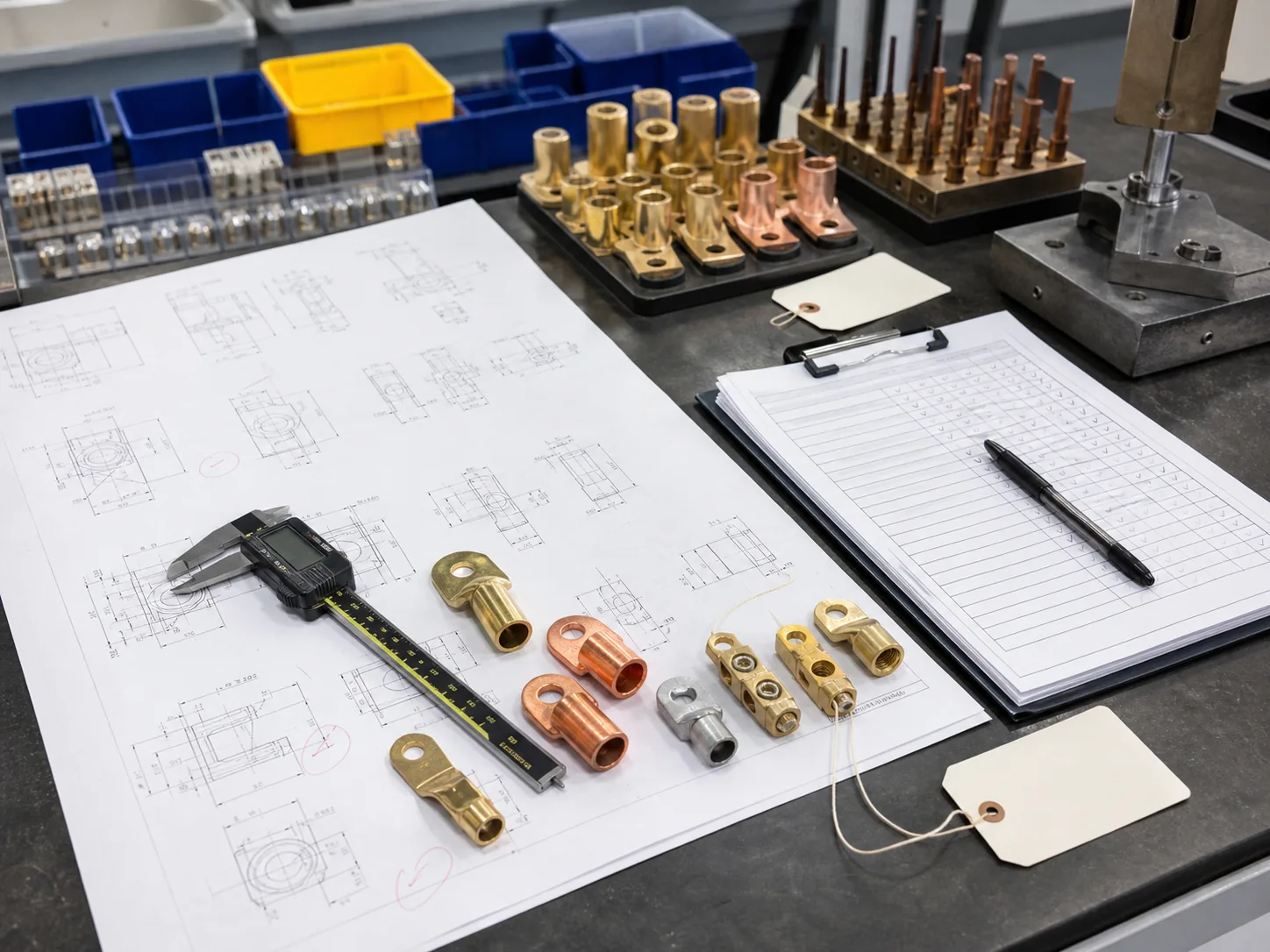
Choosing a binding-post material for OEM equipment is not a branding decision. It is a drawing and interface decision: identify which part carries the functional load, how it mates with the panel and cable, what finish zones matter, and how the approved sample will be inspected before repeat production.
The right material route may involve more than one material. A metal body, contact insert, nut, washer, cap, and insulating part can have different jobs. Material selection should therefore be reviewed together with the drawing, mating hardware, finish, assembly sequence, and approval plan.
Scope of this guide: OEM binding-post material selection and evidence-led drawing/sample review. It does not assign universal electrical ratings, certification, plating thickness, or safety performance, and it does not replace the buyer’s equipment validation.
Start With the Finished Interface, Not the Material Name
Before asking for a brass, copper, steel, or “premium” binding post, define:
- the equipment application and the function of the terminal;
- the panel thickness, hole, spacing, front clearance, and rear clearance;
- the mating cable, banana plug, spade lug, bare wire, pin, lug, or busbar interface;
- the rear termination and assembly access;
- contact zones, appearance zones, threaded zones, and protected surfaces;
- the sample quantity, inspection basis, packaging expectation, and release condition.
This prevents a material label from hiding the actual engineering decision. A material report can identify a tested sample, but it does not by itself establish current rating, voltage rating, temperature performance, or suitability for every equipment design.
For the current Axiterm evidence package, the available records are tied to an identified YBD-121208-R binding-post part family and related 0888-01-01 assembly. They support controlled engineering review, not a universal specification for every Binding Post product.
When a Brass Route Should Enter Review
Brass may be considered when the project needs a machined body, threaded hardware, panel fit, nut and washer control, or a stable assembly route. The useful question is not simply whether the part is called brass. Confirm which components use the material, which surfaces are functional, and which dimensions control the mating interface.
The supplied evidence package includes an SGS report for a tested Brass C3604 sample. The report records a chemical composition analysis and states that the tested result complied with the stated JIS H3250:2015 C3604 requirements. That report supports a sample-specific material discussion. It does not authorize a claim that every Axiterm binding post uses C3604 or that every production lot has the same composition without the relevant lot and specification records.
Before sampling a brass route, confirm:
- the material grade for each conductive and structural component;
- thread, shoulder, hole, and panel dimensions from the approved drawing;
- the finish and plating requirement by surface zone;
- the mating hardware and tightening or assembly method;
- the inspection points and sample acceptance basis.
When a Copper-Family Route Should Enter Review
Copper-family parts may be considered when the drawing defines a conductive path, contact surface, rear terminal, lug interface, or another function where the material route is important. Copper does not, by itself, define the finished assembly’s current, heat, voltage, or safety performance.
Mark the current path and functional contact zones on the drawing. Include the mating part so the review covers the complete interface rather than an isolated metal component. If the project also uses brass hardware, insulation, plating, or a busbar connection, keep those decisions in the same approval package.
The copper route should be reviewed with:
- contact area and mating geometry;
- burr, edge, and surface-damage risks;
- oxidation or protection requirements;
- finish or plating zones;
- rear connection and assembly clearance;
- equipment-level validation criteria supplied by the buyer.
Use the Binding Posts product page for the main owner path. For a side-by-side material decision, see the brass vs copper terminal-components guide; then use the RFQ page to send the drawing, sample, and application details.
When a Steel Route Should Enter Review
Steel may be relevant to a structural or threaded component when the design requires a defined strength, geometry, fastening, or assembly route. The material choice still needs a finish, corrosion, interface, and inspection discussion.
The supplied evidence package includes an SGS report for a tested Carbon Steel Q1951-2 sample. The report records a chemical composition analysis and states that the tested result complied with the stated GB/T 700-2006 Q195 requirement. This is evidence for the identified tested sample and report scope; it is not a blanket certification for every steel component or finished binding post.
Before approving a steel route, define the required surface condition, contact or non-contact role, finish, threaded fit, packaging protection, and acceptance criteria. If the part enters a conductive path, the electrical requirement and validation method must come from the equipment specification.
Polymer and Insulation Parts Need Their Own Review
Binding-post assemblies may include caps, shoulder washers, bushings, spacers, and other insulating parts. These parts should be reviewed against the metal component, panel, mating hardware, and assembly sequence rather than treated as an unrelated color or plastic purchase.
The supplied material package includes a test report identifying a tested polymer sample as Polyamide 6 (PA6) using FT-IR and PGC-MS methods. That supports material identification for the tested sample. It does not establish a flame rating, dielectric rating, temperature rating, or safety approval for a finished assembly.
For insulation review, provide:
- the metal-part drawing and the mating panel;
- shoulder, bore, wall, and clearance requirements;
- material and color requirements;
- assembly order and press-fit or retention assumptions;
- any equipment-level clearance, compliance, or validation requirement.
What the Quality Package Actually Adds
Material evidence becomes useful when it connects to dimensional and process control. The supplied YBD-121208-R package includes drawing and assembly records, DIM inspection, SPC studies, MSA GR&R workbooks, a process flow diagram, PFMEA, a Control Plan, and a Safe Launch Plan.
These records can support a buyer discussion about:
- which drawing characteristics were studied;
- how incoming materials and assembly steps are controlled;
- how product inspection and reaction plans are documented;
- how measurement repeatability is considered;
- how packaging and release controls fit into the process.
The records remain part-specific and source-specific. They should not be rewritten as universal claims such as “all binding posts meet this tolerance,” “all orders have zero defects,” or “all products are certified.”
RFQ Checklist for Material Selection
Send a compact package containing:
- A 2D drawing, 3D model, dimensioned sketch, reference sample, or clear photos.
- The equipment application and mating cable or terminal interface.
- The material grade for each relevant component, or a clear statement that material selection is open.
- Contact, appearance, threaded, masked, and protected surface zones.
- Panel thickness, mounting hole, spacing, rear clearance, thread, nut, and washer details.
- Insulation, color, panel-isolation, and assembly requirements.
- Sample quantity, prototype or repeat-production stage, and approval method.
- Inspection points, packaging needs, labels, and documentation requirements.
Use Send Drawing for Engineering Review when the material decision depends on the complete terminal interface. A short material name is not enough to release an OEM sample.
Frequently Asked Questions
Is brass always the best material for a binding post?
No. Brass may suit some machined and threaded routes, but the correct choice depends on the drawing, contact path, panel fit, finish, insulation, and approval requirements.
Does a copper material report prove the binding post’s current rating?
No. A material report identifies or tests a material sample. It does not establish the finished assembly’s current, voltage, temperature, or safety rating.
Can one binding-post assembly use different materials?
Yes. A drawing may assign different functions to the body, contact part, hardware, insulation, and finish. The component split must be defined and approved together.
What does a dimensional SPC study prove?
It provides process-study evidence for the identified characteristic and sample. It does not automatically become a universal tolerance or guarantee for every product family.
Can a quality package replace the buyer’s drawing and sample approval?
No. Process-flow, PFMEA, control-plan, SPC, MSA, and inspection records help explain how an identified part is reviewed and controlled. The buyer’s drawing, mating interface, material requirement, sample acceptance basis, and equipment validation still define the project release.
What should be sent when the material is not decided?
Send the drawing or sample, application, mating interface, contact path, panel constraints, finish expectations, quantity stage, and validation needs. Engineering can then review the material route as part of the complete interface.
Source and Review Boundary
This article uses the supplied YBD-121208-R / related 0888-01-01 evidence package for controlled material, dimensional, inspection, process, and sample-review guidance. The Brass C3604, Carbon Steel Q1951-2, and PA6 statements refer to the supplied tested samples and reports only. No universal tolerance, electrical rating, plating thickness, certification, MOQ, lead time, capacity, or customer case is claimed.
For the next step, review the Binding Posts product page and RFQ page before sending a drawing or sample.