
Custom Terminal Block Assembly for OEM Equipment
How OEM buyers should specify custom terminal block-style assemblies, hardware kits, insulation, packaging, and approval evidence before RFQ.
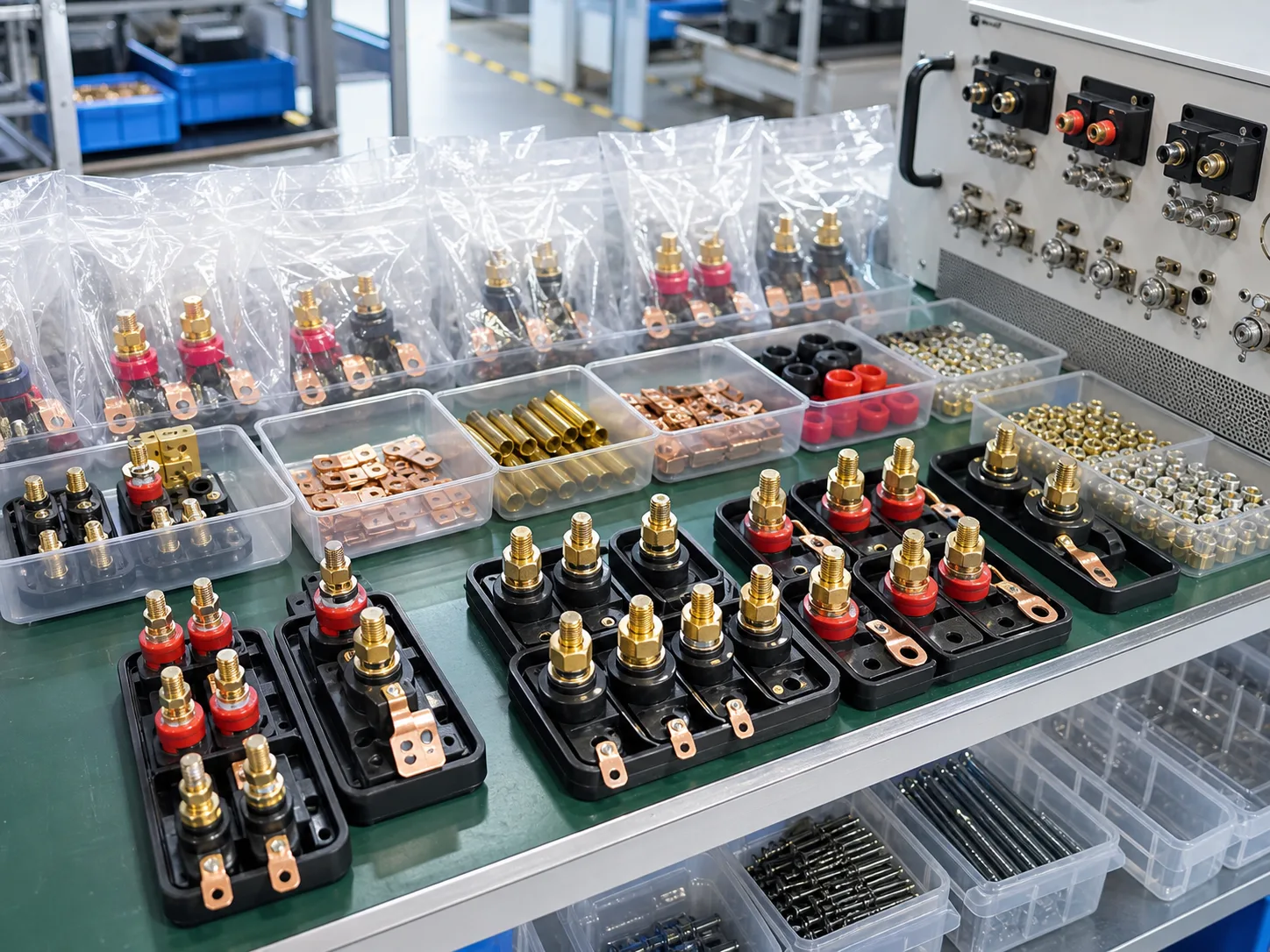
Custom terminal block assembly is not only a question of buying a terminal block. For OEM equipment projects, the real sourcing question is whether the metal terminals, molded insulation, screws, washers, labels, packaging, and approval evidence can be reviewed as one repeatable assembly.
That distinction matters. A buyer searching for a custom terminal block assembly may need a complete certified terminal block product, a modified terminal hardware set, or a drawing-based terminal component assembly for an industrial panel. Axiterm’s review scope is the third path: terminal components, machined brass or copper parts, insulation pieces, hardware kits, color coding, packaging, and repeat-production controls reviewed from drawings, samples, or an assembly requirement.
This guide explains how to decide whether a project fits that scope, what to send for engineering review, and which details prevent quote mismatch before sampling.
What Custom Terminal Block Assembly Means in an OEM RFQ
The phrase “terminal block assembly” can describe several different purchasing situations.
Some buyers mean a catalog terminal block mounted on DIN rail. Some mean a PCB screw terminal or pluggable connector. Some mean a barrier strip with certified safety requirements. Others mean a custom assembly that uses terminal posts, brass bodies, copper contact parts, molded insulation, nuts, washers, screws, labels, and packaging.
Axiterm should be considered for the last situation: a custom terminal component or terminal-block-style assembly where the buyer can provide a drawing, sample, BOM, equipment context, and approval requirement. If the project depends on a complete certified terminal block product line, a specific electrical safety listing, or a standard catalog footprint, that requirement must be stated clearly before review.
The safest RFQ language is not “Can you make a terminal block?” It is:
- What parts make up the assembly?
- Which components are machined, molded, plated, purchased, or packed as a kit?
- How does the assembly mount into the equipment?
- Which surfaces are conductive, visible, insulated, or packaged for protection?
- What sample evidence will approve the design before repeat production?
Those questions turn a vague product name into an assembly review package.
Which Projects Fit Axiterm’s Assembly Review Scope
Use this table to decide whether a project should enter Axiterm’s review path or needs a different supplier type.
| Project Situation | Fit for Axiterm Review | What to Send |
|---|---|---|
| Drawing-based terminal hardware set for industrial equipment | Good fit when machined metal parts, insulation, hardware, and packaging need to be coordinated | Drawing, exploded view, BOM, sample photos, material and finish notes |
| Custom brass or copper terminal bodies used inside a larger assembly | Good fit when geometry, plating, contact zones, burr control, and repeat production matter | Part drawings, mating interface, current path note, finish zones |
| Red/black insulated terminal assembly for a panel | Good fit when color coding, insulation fit, hardware stack, and assembly sequence must match | Panel thickness, molded parts, metal parts, washer/nut stack, color standard |
| Replacement of an existing supplier’s terminal assembly | Good fit if the buyer can provide approved samples and critical dimensions | Existing sample, known pain points, packaging reference, approval standard |
| Standard DIN rail terminal block catalog item | Needs confirmation; may be outside scope if a standard certified product is required | Required standard, certification, catalog equivalent, quantity, and approval rules |
| PCB pluggable terminal block or certified barrier strip | Usually outside scope unless only a custom metal or hardware subcomponent is needed | Exact compliance requirement and subcomponent drawing |
This boundary protects both sides. It prevents Axiterm from overpromising, and it helps the buyer decide whether the project is a custom terminal component assembly or a standard terminal block sourcing task.
Information Needed Before Engineering Review
A useful custom terminal block assembly RFQ should show the assembly, not just one part. The minimum package should include the drawing basis, the component list, the equipment interface, and the approval method.
Assembly Drawing, BOM, or Exploded View
Send an assembly drawing if one exists. If not, send an exploded sketch, sample photos, and a component list. Mark which parts are metal, which are molded plastic, which are fasteners, and which are labels, bags, dividers, or other packaging items.
For drawing-based terminal projects, the assembly order can matter as much as the part dimensions. A washer installed before an insulation shoulder may create a different result than the same washer installed after it. If the sequence is already known, send it.
Metal Parts and Contact Zones
List the machined metal parts separately. Common inputs include terminal bodies, posts, collars, sleeves, nuts, washers, conductor plates, copper contact parts, and threaded brass hardware.
Do not describe every metal surface as the same. Mark contact zones, appearance zones, thread zones, and areas that need protection during plating or packaging. The same logic applies to custom brass components and custom terminal components, where small details decide whether the assembly is repeatable.
Molded Insulation and Color Parts
If the assembly includes insulation, send the molded part drawing or sample together with the metal part it touches. Shoulder washers, bushings, caps, spacers, and color-coded parts should be reviewed against the panel and hardware stack.
For red and black parts, send color expectations as a sample approval issue, not only a color name. Paired colors should be reviewed together because the finished assembly is what the equipment user sees. The related injection molded insulation guide explains why plastic parts should be approved in assembly context.
Panel, Enclosure, or Equipment Interface
The assembly must fit into the equipment. Send the panel thickness, cutout, mounting hole, enclosure clearance, cable path, lug or wire entry, and nearby components. For industrial equipment, include the service access or replacement expectation if operators will touch the terminal area after installation.
If the assembly is used in a control panel, power interface, instrument panel, or machine enclosure, link the RFQ to the equipment context. The industrial equipment application route is useful when the buyer needs terminal hardware, enclosure fit, and packaging control reviewed together.
Assembly Risks That Cause Quote or Sample Failure
Most assembly problems begin before the supplier makes anything. The RFQ leaves out a small assumption, and that assumption becomes a sample problem later.
| Risk | Why It Happens | Review Action |
|---|---|---|
| Missing hardware in the sample set | BOM and packaging list were not separated | Send a component list with quantity per assembly and spare/accessory rules |
| Insulation does not seat correctly | Plastic and metal parts were reviewed separately | Send molded part and mating metal geometry together |
| Finish gets damaged during assembly | Contact or appearance zones were not marked | Define protected surfaces, plating zones, and handling expectations |
| Assembly sequence is slow or inconsistent | Order of washers, nuts, and molded parts was assumed | Share the intended sequence, fixture need, and operator access |
| Color pairing or labels are inconsistent | Packaging and visible approval standard were missing | Approve paired samples, label layout, bagging, and reference photos |
| Repeat orders drift from the first sample | No release basis controlled the drawing, BOM, sample, and packaging | Keep approved sample, BOM revision, drawing revision, and packing reference together |
These risks are not solved by a lower unit price. They are solved by better evidence before quotation and a clearer approval basis before repeat production.
Sample Approval and Repeat Production Control
A custom terminal block-style assembly should not move into repeat production only because each part looks acceptable. The assembled set needs its own approval.
A practical sample review covers:
- Component completeness. Each assembly contains the right metal parts, molded parts, screws, nuts, washers, labels, and accessories.
- Fit and sequence. The assembly can be built in the intended order without forcing, rework, or unplanned tooling.
- Visible quality. Color pairing, finish appearance, labels, and packaging match the buyer’s sample standard.
- Functional interface. The panel, enclosure, cable, lug, wire, or mating part fits the approved sample.
- Packaging release. Bags, trays, dividers, labels, paired sets, and shipping protection match the repeat-order requirement.
- Revision control. The approved sample, drawing revision, BOM, packaging reference, and inspection points are stored as the release basis.
That release basis matters when the buyer places the next order. Without it, the supplier may repeat the part dimensions but miss the kit contents, label, color, or packing method.
What to Send for a Custom Terminal Block Assembly RFQ
Send a compact RFQ package through the RFQ page:
- Assembly drawing, exploded view, BOM, sketch, reference sample, or sample photos.
- Function of the assembly in the equipment.
- Metal parts list: posts, terminal bodies, collars, copper contacts, screws, nuts, washers, plates, or sleeves.
- Molded parts list: caps, bushings, shoulder washers, spacers, housings, or color-coded parts.
- Material and finish requirements by component and surface zone.
- Panel, enclosure, DIN rail, PCB, cable, wire, lug, or mating interface.
- Assembly sequence, torque or fit assumptions, and service access.
- Inspection points and sample approval criteria.
- Packaging, labels, paired sets, hardware kits, private-label scope, or shipment protection.
- Prototype quantity and production quantity range.
If the RFQ includes a required electrical rating, voltage rating, certification, flame rating, or compliance mark, state that separately. This article does not claim any Axiterm rating or certification for terminal block products.
How Axiterm Reviews Terminal Assembly Projects
Axiterm reviews terminal assemblies around the manufacturing route and the approval evidence. The route may involve assembly and OEM customization, machined brass parts, copper components, molded insulation, plating, packaging, and OEM terminal development.
Some projects begin from custom terminal components. Others begin from a recognized product family such as binding posts or from industrial equipment requirements. When the project includes machined brass hardware, the custom brass components route helps define thread, shoulder, collar, bore, slot, and finish-prep details. When surface behavior matters, the plating review path helps separate contact zones from appearance zones.
The goal is not to force every request into one product category. The goal is to identify the part family, manufacturing route, assembly evidence, and RFQ inputs before sampling. If the buyer’s requirement belongs to a certified catalog terminal block, Axiterm should know that early. If it belongs to a custom terminal component assembly, the drawing and sample package can move into engineering review.
Frequently Asked Questions
Is a custom terminal block assembly the same as a standard terminal block?
No. A standard terminal block is usually a catalog product with defined footprint, ratings, approvals, and accessories. A custom terminal block-style assembly may be a drawing-based set of terminal components, insulation parts, hardware, labels, and packaging created for a specific OEM equipment interface.
Can Axiterm quote a complete terminal block product?
It depends on the required scope. Axiterm can review custom terminal component assemblies, machined metal parts, molded insulation, hardware kits, packaging, and sample approval requirements. If the buyer needs a certified catalog-style terminal block, the compliance and product-line requirements must be confirmed before quotation.
What is the most useful file to send?
An exploded view or assembly drawing is the most useful. If that is not available, send sample photos, a BOM, individual part drawings, and the equipment interface where the assembly will be installed.
What usually causes custom assembly samples to fail?
Missing hardware, unclear assembly sequence, mismatched plastic-to-metal fit, unmarked finish zones, packaging damage, color mismatch, and uncontrolled revisions are common causes. These can usually be found before sampling if the RFQ package is complete.
When should the project use OEM terminal development instead?
Use OEM terminal development when the assembly is not fully defined yet, when the buyer is replacing a supplier part, or when the design must be reviewed from equipment interface through prototype and production release.
Source and Review Boundary
This article uses Axiterm’s published assembly, custom terminal component, OEM terminal development, industrial equipment, injection molding, plating, and RFQ pages as the source for Axiterm’s review path. GSC data was used to identify the query opportunity and page-ownership gap. No external source or competitor claim is used to establish Axiterm capability.
Method and limitation note: final scope, electrical suitability, certification, material grade, tolerance, inspection method, MOQ, lead time, and packaging approval depend on the buyer’s drawing, sample, equipment context, and project evidence. No Axiterm electrical rating, voltage rating, safety certification, exact tolerance, MOQ, lead time, or customer case is claimed here. Reviewed by Gben, Marketing Manager.