
OEM Hardware Customization for Terminal Assemblies
How OEM buyers should specify custom terminal hardware, assembly sets, packaging, revision control, and sample release before RFQ.
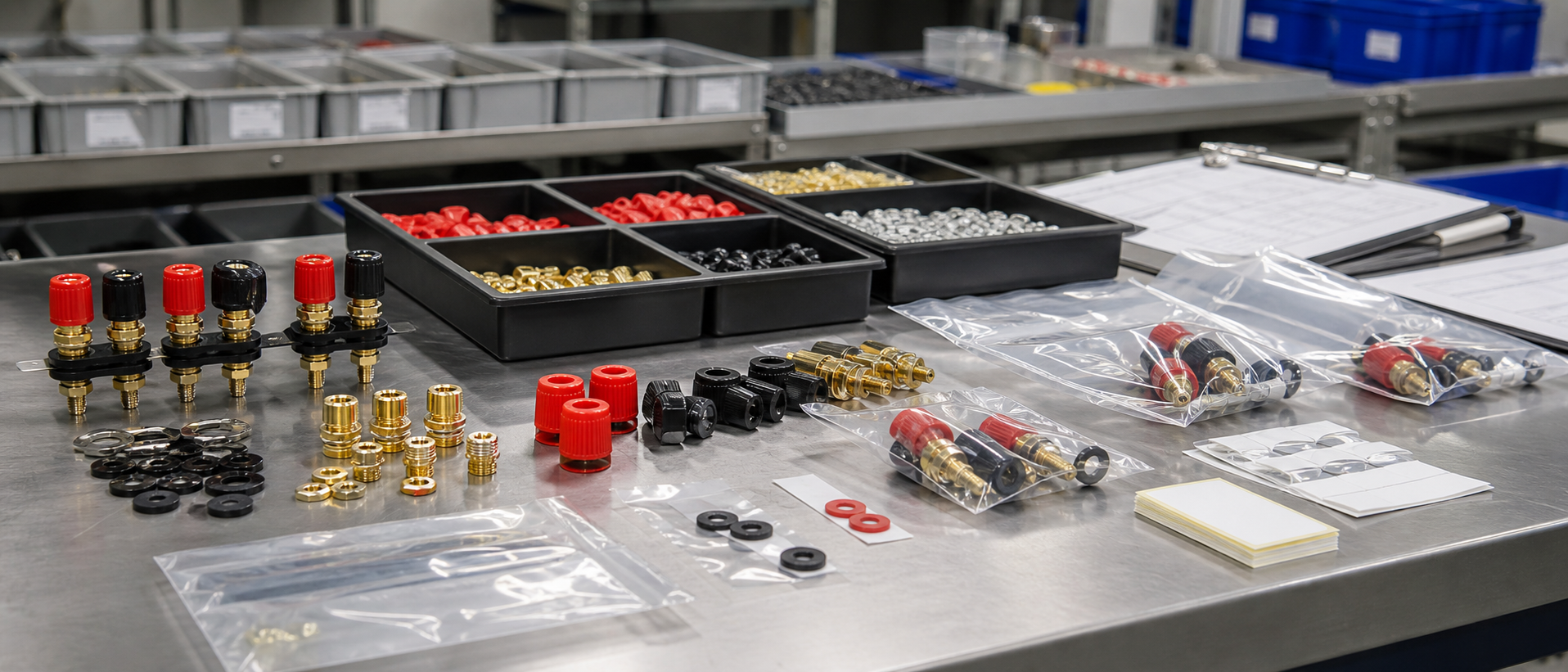
OEM hardware customization for terminal assemblies should not start with logo, color, or packaging. Those details matter, but they only become useful after the buyer and supplier agree on the assembly basis: which metal parts, insulation parts, washers, nuts, labels, bags, dividers, and inspection points must stay together as one repeatable release package.
Our view is that customized hardware is a production-control problem before it is a branding problem. If the approved sample, BOM, assembly order, color pairing, packaging reference, and revision rule are not tied together, a supplier can ship a set that looks close but is not ready for repeat OEM use.
This guide explains how to prepare an RFQ for OEM terminal hardware customization without turning the request into a generic packaging or private-label inquiry.
Axiterm’s Supplier Judgment: What We Would Check First
For OEM sourcing, we would not start by asking whether a logo, bag, or hardware kit can be customized. The safer starting point is whether the customized set has a controlled assembly definition.
Before treating an OEM hardware customization project as ready for quotation, check these points first:
- Assembly basis before branding. A label or private box cannot fix an unclear component list, mixed washer stack, wrong nut, missing insulation piece, or unapproved sample.
- BOM before unit price. The quote should identify what is included in each set, what is packed separately, what is optional, and what changes by product variant.
- Fit check before packaging design. Red/black terminals, nuts, washers, molded insulation, and panel hardware should be checked together before the packing method is frozen.
- Revision control before repeat orders. If drawings, samples, packaging photos, and labels are not controlled together, the second order can drift from the approved first order.
- RFQ scope before supplier selection. If the buyer only needs consumer retail packaging, this is not the right page. If the buyer needs terminal hardware assembled, checked, protected, and released for OEM equipment, assembly review matters.
Do not decide by packaging appearance, logo option, or the phrase “custom hardware” alone. For terminal components, the useful supplier is the one that asks for the sample set, mating interface, BOM, inspection points, and packaging release basis before quoting the customized package.
What Counts as OEM Hardware Customization?
In this context, OEM hardware customization means terminal-related component sets prepared for a buyer’s equipment, brand, assembly line, service kit, or repeat production program. It can include metal terminal parts, molded insulation, nuts, washers, screws, color-coded components, labels, protective packaging, and release documentation.
Common examples include:
- Binding post hardware sets with red/black parts, nuts, washers, and insulation.
- Banana jack or panel-terminal kits packed for equipment assembly.
- Custom terminal components supplied with matching screws, collars, bushings, or molded parts.
- Hardware bags or trays organized by product variant, left/right position, color, or installation step.
- Private-label terminal sets where packaging, label, color, and visible finish must match a buyer’s program.
- Replacement supplier kits where the approved sample set and packing method must remain consistent.
Axiterm’s strongest fit is not generic retail packaging. The fit is terminal component assembly and OEM customization where the buyer needs hardware completeness, assembly sequence, packaging protection, and repeat-order control.
Which Requests Fit the Assembly Review Scope?
Use this table before sending an RFQ.
| Request Type | Fit for Axiterm Review | What to Confirm |
|---|---|---|
| Binding post hardware kit | Good fit | Terminal body, nut, washer, insulation, color pairing, panel fit, packaging |
| Banana jack or panel terminal set | Good fit | Mating plug, mounting hardware, red/black parts, visible finish, label needs |
| Custom terminal assembly with loose accessories | Good fit when drawings or sample sets are available | BOM, assembly order, accessory count, inspection points, packing method |
| Private-label terminal component packaging | Good fit when the product structure is already clear | Label artwork, bag or tray format, product protection, approval reference |
| Replacement of an existing hardware kit | Good fit if approved sample and packing reference are available | Existing sample set, known failure point, critical components, repeat-order rule |
| Pure consumer retail packaging project | Usually outside scope | Whether the request involves terminal components or only packaging design |
| Safety-certified assembly, rated connector system, or regulated power device | Hold unless only a custom terminal subcomponent or kit is needed | Compliance requirement, rated system owner, exact subcomponent drawing |
This boundary keeps the article aligned with OEM terminal component assembly instead of unsupported consumer packaging or certified product claims.
RFQ Details That Decide the Quote
A useful RFQ starts with the release package, not only the final appearance. If a supplier quotes from a product photo and a bag size without asking for the BOM, sample basis, assembly order, and inspection points, the quote may be too thin for OEM repeat production.
BOM, Component Count, and Variant Rules
List every component in the set: terminal bodies, nuts, washers, screws, spacers, insulation pieces, caps, labels, bags, trays, inserts, and any loose accessories. If the red and black versions use different parts, say so. If two product variants share most components but use different hardware, separate them before quotation.
This is where terminal component assembly becomes more important than a simple packing request. The buyer is not only buying parts; the buyer is buying a controlled set.
Assembly Order and Fit Checks
Explain which parts are assembled before shipment and which parts remain loose for the buyer’s line. If the hardware must fit a panel, enclosure, binding post, cable lug, or molded insulation part, include that context.
For projects that are still changing, route the request through OEM terminal development so interface review, sample approval, packaging, and production release can be handled together.
Logo, Label, Color, and Private-Label Scope
Branding should be defined after the product structure is stable. Include label size, label text, logo file, color requirement, bag or box format, barcode or lot-code need, and whether the packaging is buyer-facing or only used for production control.
Do not let packaging design hide an unresolved technical issue. Color mismatch, loose washer counts, wrong insulation piece, or mixed revisions will matter more than a neat label when the assembly reaches the buyer’s line.
Packaging Protection and Surface Risk
Terminal hardware can be damaged by poor packing even when machining and plating are acceptable. Identify visible surfaces, plated surfaces, threaded areas, insulation pieces, and parts that must not rub during transport.
If finish appearance or contact zones matter, connect the assembly RFQ to plating and finish review before approving packaging.
RFQ Inputs for OEM Hardware Customization
Send a compact package through the RFQ page or email review channel:
- Approved sample set, exploded view, BOM, drawing, or clear photos of all parts.
- Product function inside the equipment, terminal, binding post, panel, cable interface, or service kit.
- Component list with quantity per set and variant differences.
- Assembly order: pre-assembled parts, loose accessories, and buyer-side installation steps.
- Material, finish, color, insulation, and visible-surface expectations.
- Packaging requirement: bag, tray, divider, label, barcode, carton, private-label, or protective packing.
- Inspection points: completeness check, fit check, color pairing, finish protection, label accuracy, and packing verification.
- Quantity range, sample quantity, repeat-order expectation, and project stage.
- Approval basis: who approves sample, packing photo, label, BOM, and revision changes.
If any requirement depends on electrical rating, voltage, safety certification, exact torque, exact tolerance, controlled test method, MOQ, or lead time, include it as a buyer requirement for separate review. This article does not claim those values for Axiterm.
Common Risks Before Sample Approval
| Risk | Why It Happens | Prevention Before RFQ |
|---|---|---|
| Hardware kit is incomplete | BOM and quantity per set were not controlled | Send BOM, sample set, and completeness checklist |
| Red/black or left/right variants are mixed | Variant rules were treated as packaging notes | Separate variants and approve reference photos |
| Parts fit individually but not as a set | Assembly order, panel fit, or mating parts were missing | Send equipment context and fit-check basis |
| Finish or visible surfaces are damaged | Packing allows plated or visible parts to rub | Mark protected surfaces and packaging method |
| Label is approved but product changes | Label, BOM, and revision records are not tied together | Control label and component revision together |
| Repeat order differs from sample | Sample, drawing, packing photo, and inspection points are separated | Keep release package as one approved record |
These risks are usually cheaper to fix before quotation than after the first shipment is rejected for a missing washer, mixed color set, or unprotected finish.
How This Fits with Custom Terminal Components
OEM hardware customization is often one layer of a broader terminal component project. A buyer may begin with a recognized binding post family, a custom brass body, a molded insulation piece, or a complete equipment interface.
Use custom terminal components when the hardware belongs to a drawing-based terminal interface. Use binding posts when the set starts from a binding-post product family. Use custom brass components when the main risk is turned or machined brass hardware. Use industrial equipment when the set belongs to a machine, control panel, enclosure, or repeated industrial assembly.
The correct path can change after review. A simple hardware bag may become an assembly-control project if color pairing, insulation fit, protected finish, and repeat-order packaging must be controlled together.
Sample Release Checklist for Repeat Orders
Before repeat production, the approved sample should confirm more than the customized label. Review:
- BOM basis. Every part in the set, quantity per set, optional part, and variant rule is defined.
- Assembly basis. Pre-assembled parts, loose accessories, and buyer-side installation steps are clear.
- Fit basis. The set works with the panel, enclosure, cable, mating terminal, insulation, or hardware stack.
- Appearance and finish basis. Visible surfaces, plated surfaces, protected threads, and acceptable marks are defined.
- Packaging basis. Bag, tray, label, divider, carton, and protection method are approved.
- Inspection basis. Completeness check, fit check, label check, color check, and packing check are documented.
- Revision basis. Any change to part, color, finish, label, packaging, or BOM is controlled before repeat orders.
That release basis is what makes customized hardware repeatable. Without it, a supplier can reproduce the packaging style but lose control of the terminal assembly.
Frequently Asked Questions
Is OEM hardware customization the same as private-label packaging?
Not exactly. Private-label packaging is one part of the scope. For terminal assemblies, OEM hardware customization also includes component completeness, assembly order, fit checks, protected surfaces, revision control, and repeat-order release.
Can Axiterm review hardware kits for binding posts or terminal assemblies?
Axiterm can review terminal-related hardware kits when the buyer provides a sample set, BOM, drawings, mating interface, packaging requirement, and approval basis. Pure packaging-only projects or regulated finished systems require separate scope confirmation.
What is the most important RFQ detail?
The most important detail is the approved release package: BOM, sample, drawing or photo reference, packaging method, inspection points, and revision rule. Without that, the supplier may quote the visible package but miss the repeat-production requirement.
Should packaging be designed before sample approval?
Usually no. Packaging can be planned early, but final approval should follow the product structure, component count, fit check, finish protection, and buyer inspection requirement.
When should the project use OEM terminal development?
Use OEM terminal development when the hardware kit is part of a new or modified terminal interface, or when the buyer needs assembly sequence, packaging, material, finish, and sample release reviewed together.
Source and Review Boundary
This article uses Axiterm’s Assembly, Custom Terminal Components, OEM Terminal Development, Custom Brass Components, Binding Posts, Plating, RFQ, and Industrial Equipment pages as the source for Axiterm’s review path. GSC and SEO Commander data were used to identify the oem hardware customization signal and the assembly-page opportunity.
Method and limitation note: final scope, assembly route, material, finish, packaging, inspection method, certification, MOQ, lead time, and release approval depend on the buyer’s sample set, BOM, drawings, mating interface, equipment context, and project evidence. No Axiterm electrical rating, voltage rating, safety certification, exact tolerance, inspection equipment, MOQ, lead time, or customer case is claimed here. Reviewed by Gben, Marketing Manager.