Choosing an OEM Binding Post Manufacturer
A practical supplier evaluation checklist for OEM binding posts, covering drawings, materials, plating, samples, inspection, capacity, and quotations.
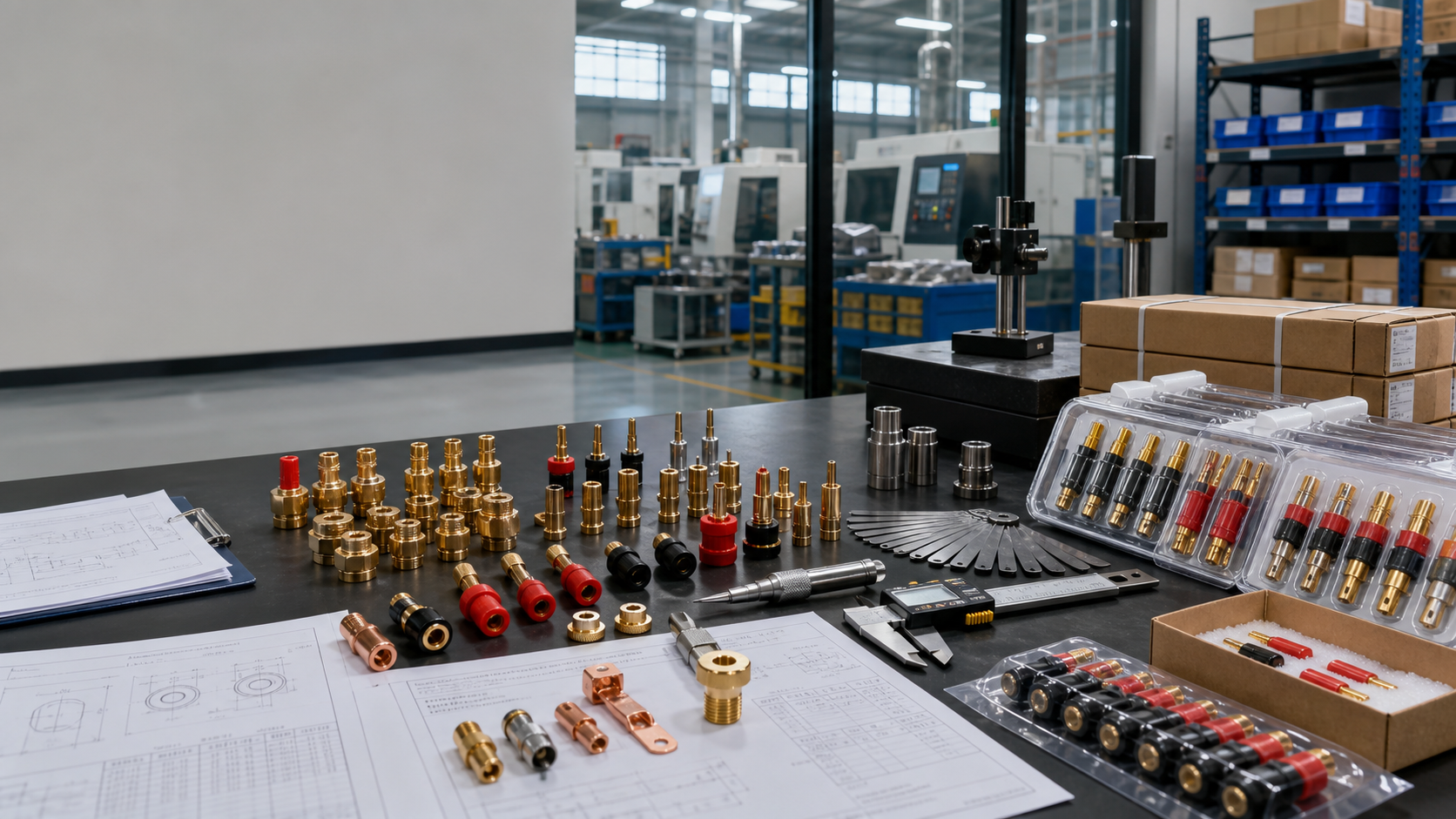
Choosing a binding post manufacturer is not just a matter of comparing unit prices. For an OEM project, the supplier must control the machined metal parts, insulation components, surface finish, assembly, inspection, and packaging as one repeatable process.
A low quote means little if the sample does not fit the panel, the plating changes between batches, or the internal termination creates extra assembly work. The better approach is to evaluate suppliers against the finished product requirement.
Start With the Drawing, Not the Catalog Photo
Two binding posts can look nearly identical and still differ in thread geometry, mounting length, cross-hole position, insulation diameter, rear termination, and compatible cable size.
Before requesting a final quotation, provide as much of the following as possible:
- 2D drawing or dimensioned sketch
- STEP, STP, IGES, DXF, or DWG file when available
- Panel thickness and mounting-hole dimensions
- Required external cable interfaces
- Rear connection or internal assembly method
- Material and surface-finish expectations
- Red/black or custom color requirements
- Estimated prototype and annual quantities
- Packaging and labeling requirements
If no drawing exists, send a physical reference sample and identify which details may or may not change. A capable supplier should turn that information into a controlled specification before production.
Confirm What the Factory Actually Manufactures
“Manufacturer” can describe several very different businesses. Some suppliers machine the conductive parts but outsource insulation, plating, and assembly. Others purchase complete products and only add packaging.
Neither model is automatically wrong, but the supply chain must be transparent. Ask which processes are performed in-house and which are subcontracted:
- CNC turning or automatic lathe machining
- Copper and brass component production
- Thread cutting and dimensional inspection
- Nylon or plastic insulation molding
- Gold, rhodium, nickel, or other surface treatment
- Final assembly and polarity color matching
- Functional inspection and packaging
The answer helps you understand who controls corrective action when a problem crosses multiple processes.
Review Material and Plating Specifications
Terms such as “pure copper,” “brass,” and “gold plated” are incomplete purchasing specifications. They do not identify the material grade, which individual components use it, the coating system, or the inspection method.
Ask the supplier to define:
- The material for each conductive component.
- The material for caps, nuts, washers, and rear terminals.
- The insulation material and color standard.
- The surface-treatment stack and controlled appearance.
- The documents or inspection records supplied with an order.
If your application has a compliance or performance requirement, include it in the request for quotation. Do not assume a catalog product has been validated for your equipment.
Use Samples to Validate the Whole Interface
A sample review should include more than visual inspection. Assemble the binding post into the real panel and test it with the cables and connectors your customer will use.
Check:
- Fit through the mounting hole
- Clearance around the insulation shoulder
- Cap travel and thread feel
- Spade connector clamping area
- Banana plug insertion and retention
- Bare-wire access through the cross hole
- Rear assembly access
- Red/black color consistency
- Surface appearance after installation
- Packaging protection after transport
Record the accepted configuration. Photographs are useful, but a signed drawing, approved sample, or inspection specification gives production teams a much clearer reference.
Ask How Quality Is Controlled
Good supplier evaluation questions are specific enough to expose the actual process:
- Which dimensions are inspected on incoming, in-process, and finished parts?
- How are thread fit and assembly consistency checked?
- How are material lots identified and traced?
- How is plating appearance or thickness verified when specified?
- Is a first-article inspection available?
- How are approved samples linked to production orders?
- What happens when a batch fails inspection?
Do not accept a certification logo as a substitute for product-level controls. Certifications can support a quality system, but the binding post still needs its own drawing, inspection plan, and acceptance criteria.
Compare Quotations on the Same Basis
Before choosing the cheapest quotation, normalize what each supplier includes. Confirm:
- Material and finish
- Included mounting hardware
- Logo or private-label requirements
- Tooling or development charges
- Sample quantity and sample cost
- Production MOQ
- Packaging configuration
- Inspection documents
- Incoterm and shipping assumptions
- Sample and production lead time
A quotation with missing specifications may appear cheaper simply because the supplier priced a different product.
Evaluate Prototype and Volume Support Separately
Prototype work rewards flexibility and quick technical communication. Volume production depends on process control, tooling stability, material availability, capacity planning, and batch consistency.
Ask how the supplier transfers an approved prototype into production. The best answer should describe controlled drawings, sample approval, material requirements, inspection points, packaging instructions, and change management.
This is especially important when a project moves from a few engineering samples to recurring OEM orders.
Watch for Common Supplier Red Flags
Pause the evaluation if a supplier:
- Refuses to identify material or outsourced processes
- Quotes from a photo without confirming critical dimensions
- Uses “same as sample” as the only production specification
- Cannot explain how approved samples are controlled
- Makes performance or certification claims without documentation
- Changes material or finish language between the quote and invoice
- Pushes volume production before the assembled sample is approved
These warning signs do not prove the factory will fail, but they increase the buyer’s verification burden.
A Practical Shortlist Process
Use a simple sequence:
- Send the same technical package to each candidate.
- Compare the questions they ask, not only their prices.
- Request samples based on a controlled drawing.
- Test samples in the actual equipment.
- Document corrections and approve a final version.
- Confirm the inspection and packaging plan.
- Start with a controlled production batch before scaling.
The supplier that identifies risks early may be more valuable than the one that sends the fastest quote.
Discuss Your Binding Post Project
Explore our binding post product range, review related terminal component solutions, and see the available manufacturing processes.
For a supplier review or OEM quotation, upload your drawing and project requirements. Include the panel interface, cable connection method, material and finish expectations, estimated annual quantity, and target validation schedule.