
Terminal Component Sample Approval Checklist for OEM Projects
A practical OEM checklist for reviewing terminal component samples, fit, finish, inspection points, packaging, and repeat-production release.
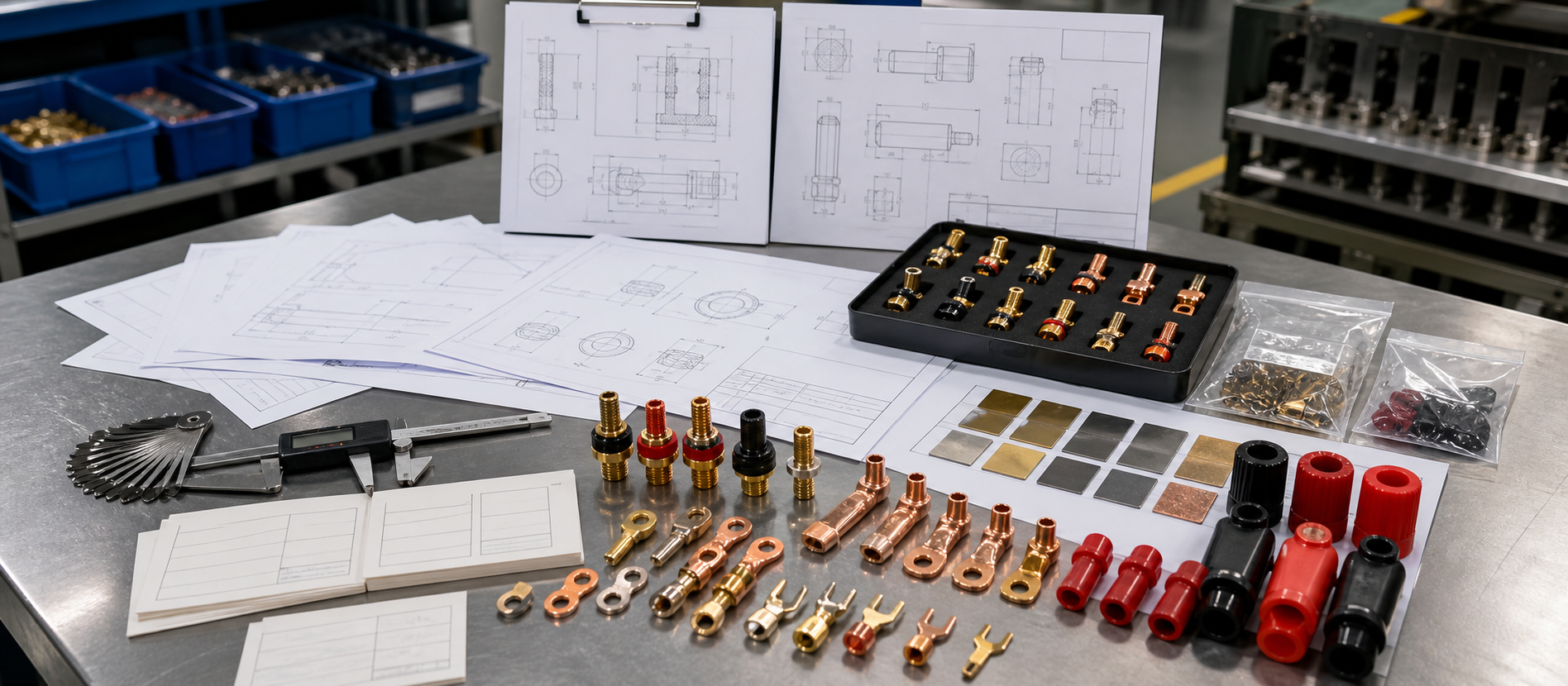
An OEM terminal component sample should be approved against a controlled drawing, mating interface, finish reference, and acceptance checklist—not judged only by appearance. The sample review should answer one question: is this the approved reference for fit, function, finish, assembly, and repeat-production control?
Our supplier view is simple: a sample is not automatically a production release. It becomes useful only when the buyer records what was checked, what was accepted, what remains open, and which revision controls the next order.
This checklist applies to binding posts, brass and copper terminal parts, panel terminals, spade connectors, insulation parts, and custom terminal assemblies.
What Should a Terminal Component Sample Prove?
A useful sample review should confirm five areas:
- Identity: part number, drawing revision, sample date, quantity, and variant.
- Fit: mating plug, lug, wire, panel, nut, washer, enclosure, or insulation interface.
- Function: the surfaces and interfaces that perform the intended connection or assembly task.
- Finish: contact zones, appearance zones, protected areas, threads, and approved visual reference.
- Release control: inspection notes, open issues, packaging reference, and approval owner.
If the sample does not have a clear reference revision, it can be difficult to prove which version was approved later.
Start with the Controlled Reference
Before checking the physical part, collect the documents that define the review:
- Current drawing or marked-up sample reference.
- Part number, variant, and revision.
- Approved material or open material decision.
- Finish name, finish zones, and visual reference where relevant.
- Mating parts and assembly context.
- Quantity and project stage.
- Inspection points and approval owner.
The terminal component RFQ guide explains how to prepare this package. If a drawing and the physical sample disagree, record the discrepancy as an open engineering decision rather than silently choosing one.
Check Fit in the Real Assembly Context
Loose-part inspection is not enough when the component interfaces with other hardware. Review the sample with the parts that control installation or use:
- plug, lug, cable, socket, or mating contact;
- mounting panel, hole, shoulder, nut, and washer stack;
- molded cap, bushing, sleeve, or insulation part;
- enclosure, bracket, or assembly fixture;
- adjacent parts that affect clearance, orientation, or access.
Record whether the review is dimensional, functional, visual, or assembly-based. A part can look correct by itself while still showing thread travel, panel-fit, insulation, or clearance issues after assembly.
Review the Functional Surfaces
Mark the surfaces that matter before deciding whether the sample is acceptable:
| Review area | Questions to record |
|---|---|
| Contact zone | Does the mating interface match the drawing, sample, or approved reference? |
| Threaded zone | Does the mating hardware engage as expected, without treating an unverified tolerance as approved? |
| Panel-fit zone | Do the shoulder, hole, nut, washer, and enclosure relationships match the assembly? |
| Insulation interface | Does the cap, bushing, sleeve, or molded part fit the approved stack? |
| Appearance zone | Does the visible finish match the approved reference under the agreed review condition? |
| Protected area | Are masked, covered, or protected areas treated separately from broad appearance surfaces? |
The purpose is to connect the inspection to the part’s job. Do not convert a visual sample review into an unsupported claim about current rating, voltage, temperature, or compliance.
Review Material and Finish Without Overclaiming
The sample review should state what is known and what still needs confirmation:
- material named on the drawing or supplied with the sample;
- material alternative under engineering review;
- finish reference and the zones where it applies;
- contact, threaded, protected, and appearance surfaces;
- visual, dimensional, functional, or laboratory checks required by the buyer;
- any certificate, test report, or specification still marked
DATA NEEDED.
For a finish-sensitive part, route the review to plating and finish zones and the plating capability page. This article does not assign a plating thickness, salt-spray result, adhesion result, certification, or electrical performance value to Axiterm.
Use a Sample Review Record
| Record field | Example of a controlled entry |
|---|---|
| Part identity | Part number, variant, drawing revision, sample date |
| Quantity checked | Number of pieces and whether all variants were represented |
| Fit reference | Panel, mating hardware, insulation, or assembly used |
| Critical observations | Feature, zone, or interface reviewed |
| Result | Accepted, accepted with action, rejected, or pending evidence |
| Open issue | Exact question, owner, and required evidence |
| Approval owner | Buyer, engineering, quality, or project owner |
| Release reference | Approved sample photo, drawing, inspection note, or packaging reference |
Use specific observations. “Quality good” does not explain what was checked or what the next supplier should reproduce.
Separate Accepted, Conditional, and Rejected Samples
Three labels are usually more useful than a single pass/fail comment:
Accepted
The sample matches the current reference for the reviewed scope, and the approval owner has recorded the release reference. Any unreviewed requirement remains explicitly outside the approval.
Accepted with action
The sample is usable for the next step, but a defined issue remains open. Record the issue, responsible owner, due point, and whether the next sample or drawing revision must resolve it.
Rejected or pending evidence
The sample does not match the required fit, finish, assembly, or documented acceptance basis, or a required proof document is missing. Do not treat a missing certificate, test result, or engineering decision as an invisible pass.
Check Packaging and Variant Control
Packaging belongs in sample approval when it affects the approved configuration. Review:
- loose parts versus pre-assembled sets;
- variant labels and part-number separation;
- protection for visible or finished surfaces;
- washers, nuts, caps, and other completeness items;
- approved photo or packing reference;
- handling that could change the sample’s appearance before the next review.
This does not claim a specific packaging method for Axiterm. It defines the questions an OEM buyer should control before repeat production.
Release the Approved Sample into Repeat Production
Before the next order or repeat build, connect the approved sample to:
- The drawing and revision that control the geometry.
- The approved material and finish decision.
- The mating hardware and assembly context.
- The inspection points and open-issue status.
- The approved sample photos or physical reference.
- The packaging, labeling, and variant reference.
- The person authorized to approve a change.
This is the handoff point to OEM terminal development and custom terminal components. For a complete component or set, also review terminal component assembly.
Sample Approval Checklist Before RFQ Release
- Part number, variant, drawing revision, and sample date are recorded.
- Mating hardware and assembly context are available where fit depends on them.
- Contact, thread, panel-fit, insulation, protected, and appearance zones are identified.
- Material and finish decisions are separated from open engineering questions.
- Required inspections are written as observable checks.
- Open issues have an owner and next decision point.
- Packaging, labeling, variant, and completeness requirements are recorded.
- Approval owner and release reference are named.
- Unsupported ratings, certifications, test results, tolerances, MOQ, and lead time remain unclaimed unless evidenced.
If this checklist is ready, send the drawing, sample photos or physical reference, mating-interface information, and project stage through the RFQ page for engineering review.
Frequently Asked Questions
Is a visual sample approval enough?
Only for the visual scope it actually covers. Fit, assembly, material, finish zones, inspection, packaging, and performance requirements need their own review basis when they matter to the project.
What should be approved first: the drawing or the sample?
They should be reviewed together. The drawing controls defined geometry, while the sample can reveal assembly, finish, packaging, or reference details that the drawing does not show.
Can a sample be accepted with open issues?
Yes, if the open issues are explicit, assigned, and excluded from the approved scope until resolved. Do not treat conditional approval as unrestricted production release.
Do I need to send mating parts?
Send them when thread engagement, contact, panel fit, insulation, clearance, or assembly completeness depends on them. A loose terminal component cannot prove an assembly interface by itself.
Does sample approval prove electrical performance or certification?
No. Those requirements need the buyer’s specified test basis and supporting evidence. This article does not assign Axiterm ratings, certifications, tolerances, test results, or compliance outcomes.
Source and Review Boundary
This article uses Axiterm’s RFQ, OEM Terminal Development, Custom Terminal Components, Binding Posts, Plating, Assembly, and existing product-evidence guidance as the source path. It is an RFQ-support and sample-control article, not a public product specification.
Method and limitation note: sample acceptance depends on the buyer’s drawing, physical reference, mating interfaces, finish requirements, inspection basis, and project evidence. Reviewed by Gben, Marketing Manager; engineering approval remains required for performance-sensitive or compliance-sensitive requirements.