
Terminal Components for Audio Equipment OEM Projects
An OEM guide to specifying terminal components for audio equipment, including panel fit, speaker interfaces, insulation, finish zones, assembly, and RFQ review.
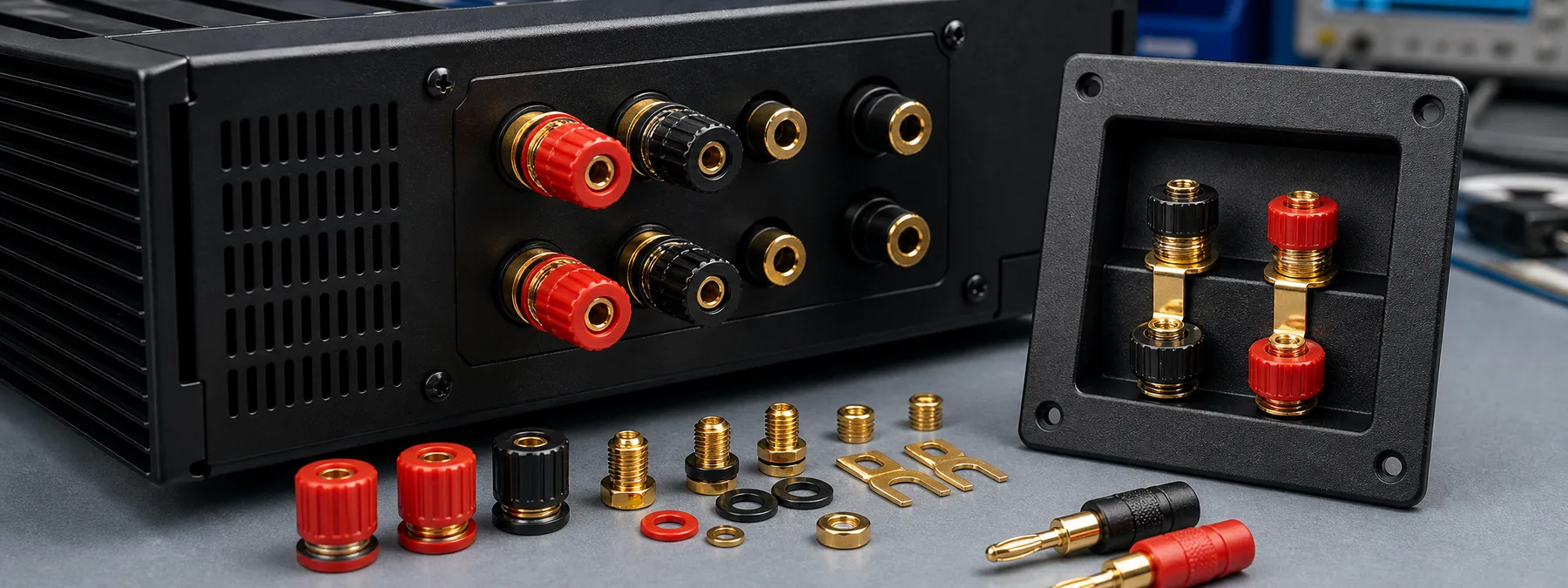
Terminal components for audio equipment should be reviewed as part of the enclosure, panel, cable, speaker interface, and assembly—not as isolated hardware. An OEM buyer needs to confirm the front interface, rear termination, mounting geometry, insulation, finish, labeling, and service workflow before approving a sample.
The audio equipment application page is the primary application owner. This article supports that page with a practical review path for OEM projects. It does not assign an electrical rating, certification, acoustic result, or universal compatibility to any Axiterm product.
What Should an Audio Equipment RFQ Define?
Start with the equipment context and connection job:
- Equipment role: amplifier, speaker enclosure, test interface, control panel, rack unit, or custom audio assembly.
- Connection type: banana plug, spade lug, wire, cable, probe, harness, or a defined mating part.
- Installation context: panel thickness, cutout, spacing, rear clearance, enclosure depth, and nearby hardware.
- Assembly scope: loose terminal, hardware set, pre-assembled unit, label set, or packaged variant.
- Service workflow: repeated connection, operator access, replacement, inspection, or fixed installation.
- Release basis: drawing, sample, marked photo, inspection points, packaging reference, and approval owner.
If a requirement is not decided, mark it TBD or “supplier review required.” Do not turn an assumed rating, material grade, or finish into a public product claim.
Match the Terminal to the Audio Interface
The same words can describe different OEM interfaces. Separate the interface before choosing the part:
| Audio interface | Review questions |
|---|---|
| Speaker binding-post interface | Panel opening, spacing, front access, rear termination, insulation, and mating plug or lug |
| Amplifier or rack-panel interface | Enclosure thickness, tool access, labeling, cable routing, and service clearance |
| Test or measurement connection | Repeat access, probe or plug interface, identification, and sample method |
| Internal harness or terminal assembly | Wire route, retention, insulation, assembly order, and packaging |
| Custom audio hardware | Drawing revision, mating parts, finish zones, inspection basis, and variant control |
The table defines an engineering review scope. It does not prove a product rating, compliance status, impedance result, power-handling result, or machine-level safety outcome.
Check Panel Fit and Rear Clearance
Audio enclosures often look simple from the front while the rear side has limited room for nuts, washers, wires, and tools. Include these fields in the drawing or RFQ:
- panel thickness and cutout or mounting-hole information;
- center-to-center spacing and orientation;
- front clearance for plugs, lugs, covers, and operator access;
- rear clearance from the enclosure wall, PCB, shield, cable, and adjacent hardware;
- shoulder, nut, washer, spacer, and insulation stack;
- wire or cable routing and bend space;
- assembly sequence before the enclosure is closed;
- service and replacement access.
Review the terminal in a representative panel or enclosure. A loose component can pass a visual check while the installed assembly blocks a tool, touches a nearby part, or leaves no practical cable route.
Separate Contact, Insulation, and Identification Decisions
Audio terminal assemblies normally require three separate decisions:
- Contact interface: the terminal body, contact area, thread, lug face, plug interface, or rear connection.
- Insulation interface: shoulders, bushings, caps, spacers, barriers, and panel-isolation features.
- Identification interface: polarity, channel marking, color, label, orientation, and variant control.
Do not use a color or plating name as a substitute for insulation geometry or polarity identification. When the project includes molded insulation, route the review through injection molding. When it includes a hardware kit or pre-assembly, use terminal component assembly.
Define Material and Finish by Function
Material and finish decisions should follow the drawing, contact zones, machining route, mating interface, and appearance requirements. Ask:
- Is the part a binding-post body, contact element, threaded hardware, mounting part, or assembly component?
- Which surfaces are contact, threaded, masked, protected, or appearance-only?
- Is the material grade fixed by the drawing or still under review?
- Does the finish need to be compared against a sample or visual reference?
- What inspection or test evidence is required before release?
- Do packaging and handling need to protect visible or functional surfaces?
Use the binding posts product page for the product-family route, and the brass versus copper terminal guide when material selection is central. A material or finish name alone does not prove conductivity, durability, corrosion resistance, certification, or audio performance.
For a zone-specific finish review, see terminal component plating finish zones and plating capability. Do not infer plating thickness, adhesion, corrosion results, or certification from a finish name.
Build a Quote-Ready Audio Equipment RFQ Package
| RFQ input | What to provide |
|---|---|
| Equipment context | Amplifier, speaker, rack unit, test fixture, enclosure, or audio assembly |
| Connection reference | Plug, lug, wire, cable, probe, harness, or mating hardware |
| Drawing or sample | Dimensions, revision, marked surfaces, photos, and physical reference |
| Panel and enclosure | Thickness, cutout, spacing, front/rear clearance, PCB, shield, and access constraints |
| Insulation and marking | Shoulder, cap, bushing, barrier, color, channel, polarity, and variant needs |
| Assembly scope | Loose parts, hardware set, pre-assembled unit, packaging, and completeness requirements |
| Material and finish | Fixed requirements, open decisions, contact zones, and visual reference |
| Inspection and release | Critical checks, sample method, revision owner, and approval record |
| Project stage | Prototype, sample, pilot, repeat production, or service replacement |
The RFQ page is the conversion owner. Send the drawing, sample, mating interface, panel context, and approval requirements so engineering can review the actual part relationship.
Sample Approval in the Enclosure
Use the representative panel, enclosure, cable, mating plug or lug, insulation, label, and packaging whenever possible:
- The terminal fits the cutout, panel thickness, spacing, and orientation.
- The intended wire, cable, lug, plug, or probe connects and routes correctly.
- The fastening stack can be assembled with the intended tools and access.
- Insulation, polarity, color, and protected areas match the approved reference.
- The enclosure closes without unreviewed interference.
- The front interface remains accessible in the installed position.
- Service and replacement access match the stated equipment workflow.
- The drawing revision, sample photos, open issues, packaging, and approval owner are recorded.
Use the terminal component sample approval checklist for detailed acceptance labels and repeat-production release. Physical sample approval does not automatically prove electrical, acoustic, environmental, or compliance performance.
Common Audio Terminal Mistakes
| Mistake | Risk created | Better action |
|---|---|---|
| Selecting by “speaker terminal” alone | Interface, enclosure, and mating hardware remain unclear | Send the panel drawing and mating reference |
| Checking only the front appearance | Rear clearance, wiring, or assembly access may fail | Review the installed enclosure |
| Treating color as complete polarity control | Channel or variant identification can remain ambiguous | Define marking, polarity, and release references |
| Leaving cable routing until assembly | The part fits but the cable cannot be dressed or serviced | Include bend space and rear access in the RFQ |
| Leaving finish zones undefined | Contact, thread, and appearance requirements can be mixed | Mark each zone and provide an approved reference |
| Mixing audio variants in one package | Similar parts can be installed in the wrong channel or revision | Separate part numbers, labels, packaging, and approval records |
Route the Project to the Correct Owner
- Use audio equipment for enclosure, panel, speaker, amplifier, and service context.
- Use binding posts when the RFQ is based on a binding-post family.
- Use custom terminal components for drawing-based parts outside a standard family.
- Use injection molding when molded insulation or bushings are part of the requirement.
- Use terminal component assembly when the RFQ includes kits, packaging, or repeat-production release.
- Use the RFQ page to send the drawing, sample, mating hardware, equipment context, and approval requirements.
Frequently Asked Questions
What should an audio equipment terminal RFQ include?
Include the equipment context, mating hardware, panel and enclosure data, drawing or sample, insulation and marking requirements, material and finish zones, inspection, release control, and project stage.
Should the terminal be checked inside the enclosure?
Yes, when fit, rear wiring, tool access, enclosure closure, polarity, serviceability, or labeling depends on the installed assembly. A loose part cannot prove every enclosure relationship.
Does a binding post automatically meet an audio power requirement?
No. Any required rating, test, safety, acoustic, environmental, or compliance evidence must be defined and reviewed for the specific project.
Can Axiterm review a custom audio terminal assembly?
Axiterm’s OEM review path can start from a drawing, sample, photo, mating hardware, or equipment description. Final material, finish, performance, compliance, and release decisions require project-specific engineering evidence.
Source and Review Boundary
This article uses Axiterm’s Audio Equipment, Binding Posts, Injection Molding, Assembly, Plating, Sample Approval, Materials, and RFQ routes as the source path. It is an application and RFQ-support article, not a public product specification.
Method and limitation note: terminal suitability depends on the enclosure drawing, connection hardware, panel, insulation, assembly, service workflow, validation plan, and project evidence. This article does not claim Axiterm ratings, acoustic results, environmental qualifications, certifications, exact tolerances, test results, MOQ, lead time, or customer outcomes. Reviewed by Gben, Marketing Manager; engineering review remains required for performance-sensitive requirements.