
Terminal Components for Power Equipment OEM Projects
An OEM checklist for selecting terminal components for power equipment, including lugs, busbars, panel fit, insulation, heat concerns, and RFQ evidence.
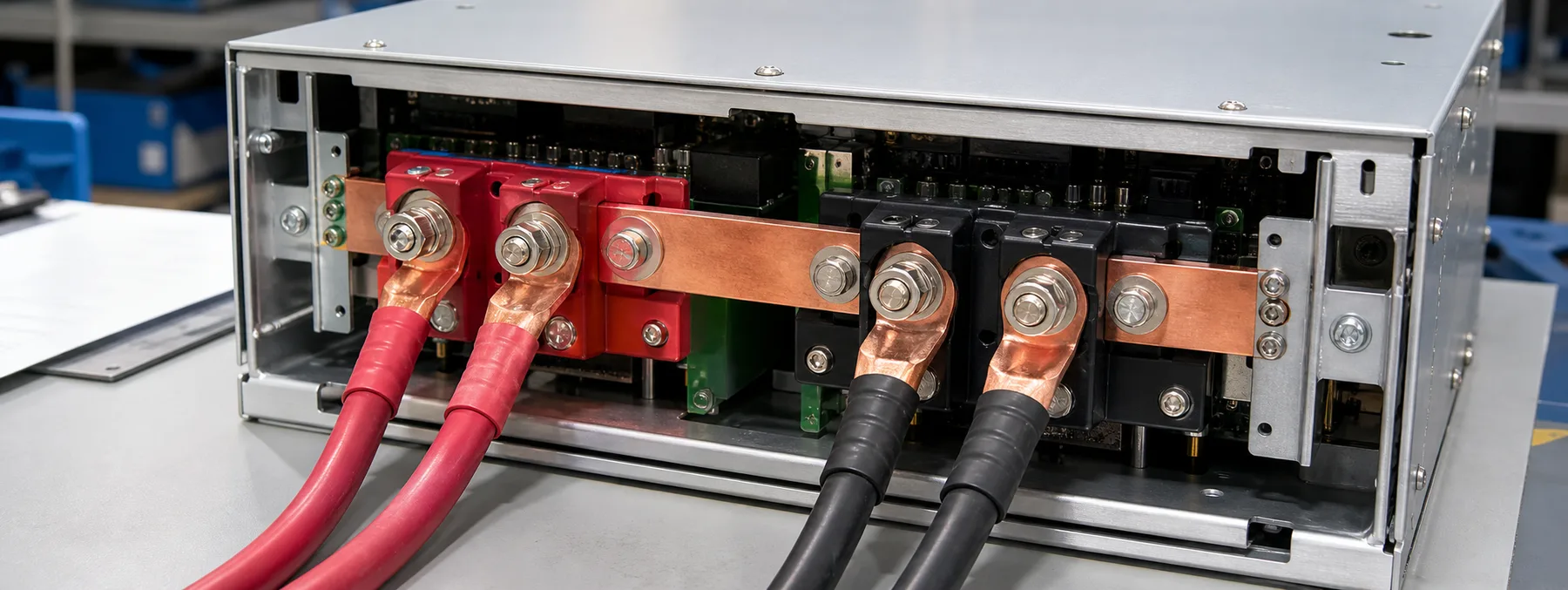
Terminal components for power equipment should be selected from the complete connection and enclosure design—not from a material name or a claimed current value alone. An OEM review should connect the lug, busbar, wire, panel, insulation, fastening stack, heat concern, and validation plan before a component is released.
Our supplier view is direct: a power-equipment terminal is part of a system interface. The drawing and RFQ must define the connection path, assembly geometry, protected surfaces, service access, and evidence needed to confirm the design. This guide does not assign an electrical rating to any Axiterm product.
What to Define Before Selecting the Terminal
Start with the equipment and connection job:
- Connection type: lug, busbar, wire, cable, plug, probe, or service lead.
- Enclosure context: panel thickness, mounting hole, spacing, rear clearance, shield, and nearby hardware.
- Fastening system: thread, nut, washer, stack height, tool access, and tightening method.
- Insulation boundary: shoulder, bushing, cap, spacing, separation, and protected surfaces.
- Application concern: contact path, heat review, repeated service, vibration, or assembly access.
- Validation basis: buyer requirements, test method, sample approval, and engineering reviewer.
The power equipment application page is the application owner. This article supports it by converting system-level questions into an OEM terminal RFQ checklist.
Match the Terminal to the Connection Interface
The connection interface determines what the supplier must review. A terminal for a flat lug is not specified in the same way as a terminal for a busbar, wire harness, or service lead.
| Connection interface | Review questions |
|---|---|
| Cable lug | Lug hole, flat contact area, washer stack, thread engagement, cable bend, and tool access |
| Busbar | Bar thickness, hole pattern, stack height, contact faces, enclosure clearance, and fastening sequence |
| Wire or harness | Wire size defined by the buyer, termination method, routing, strain relief, and assembly order |
| Panel service terminal | Front access, rear clearance, operator access, labels, insulation, and replacement workflow |
| Plug or test lead | Mating interface, spacing, orientation, repeated connection, and service envelope |
| Custom terminal assembly | Part list, assembly sequence, revision control, inspection, packaging, and release owner |
These are design and sourcing questions. They do not establish current capacity, temperature-rise performance, compliance, or certification without the buyer’s specified test basis and supporting evidence.
Check Panel Fit and Rear Clearance
Power equipment often has limited enclosure depth and a dense rear connection area. Send these fields with the drawing or sample:
- panel thickness and mounting-hole information;
- terminal spacing and orientation;
- front clearance for lugs, cables, covers, and service tools;
- rear clearance from enclosure walls, shields, busbars, PCBs, and adjacent terminals;
- washer, nut, spacer, insulation, and shoulder stack;
- cable bend, lug entry, and harness routing;
- assembly order before enclosure closure;
- service or replacement access after installation.
Review the component in a representative panel or fixture. A loose terminal can look acceptable while the assembled part creates a clearance, routing, or fastening problem.
Separate Contact, Insulation, and Protection
Power-equipment interfaces need three related but separate decisions:
- Contact path: which surfaces mate with the lug, busbar, wire termination, or service interface.
- Insulation path: which shoulders, bushings, caps, spacers, or panel interfaces control separation and fit.
- Protection path: which surfaces need masking, guarding, enclosure clearance, packaging, or special handling.
Do not use a color, coating name, or material name as a substitute for the actual insulation or protection requirement. Route molded insulation questions to injection molding and assembly questions to terminal component assembly.
Review Material Choices Without Turning Them into Ratings
Material selection should follow the part’s function, geometry, manufacturing route, finish, and validation plan. Ask:
- Is the part a terminal body, contact component, threaded fastener, busbar interface, or assembly hardware?
- Which surfaces are actually part of the intended connection path?
- Does the drawing fix the material grade, or is the selection still open?
- How do machining, threading, finish, insulation, and assembly interact?
- What material, finish, or test evidence must accompany the sample?
- Does the buyer require a separate engineering review for heat, corrosion, or compliance?
Use the custom copper components page and brass versus copper terminal guide as review routes. Copper or brass terminology alone does not prove a current rating, conductivity result, temperature limit, or compliance outcome.
Define Heat and Performance Requirements Explicitly
If the application has a heat or current concern, put the buyer’s requirement in the RFQ instead of implying it from the product category. Include:
- the equipment operating context;
- the connection type and mating hardware;
- the buyer’s current, voltage, temperature, or duty requirement;
- the test method, acceptance basis, and responsible reviewer;
- the insulation or separation requirement;
- the sample or prototype validation plan;
- any standard, certification, or report that must be supplied.
This article intentionally does not claim an Axiterm rating, test result, certification, tolerance, or temperature performance. Those items remain DATA NEEDED until the project has approved evidence.
Review Finish and Protected Zones
Finish requirements should distinguish visible surfaces from contact, threaded, masked, and protected areas. Record:
- finish name or approved reference;
- contact faces and lug/busbar interfaces;
- threaded areas and protected features;
- visible appearance zones;
- masking or no-finish areas;
- inspection and sample comparison method;
- any adhesion, corrosion, thickness, or compliance evidence required by the buyer.
For a finish-led project, route the scope through terminal component plating finish zones and plating capability. A finish name does not establish thickness, salt-spray performance, adhesion, or electrical behavior.
Build a Power Equipment RFQ Package
| RFQ input | What to provide |
|---|---|
| Equipment context | Power supply, control cabinet, battery equipment, test system, load equipment, or other assembly |
| Connection reference | Lug, busbar, wire, cable, plug, probe, or mating hardware |
| Drawing or sample | Dimensions, revision, marked surfaces, photos, and physical reference where useful |
| Panel and enclosure | Thickness, hole, spacing, front/rear clearance, shield, and access constraints |
| Fastening stack | Thread, nut, washer, spacer, tool access, and assembly order |
| Insulation/protection | Shoulder, bushing, cap, separation, masking, enclosure, and packaging needs |
| Material and finish | Fixed requirements, open decisions, zones, and reference sample |
| Performance basis | Buyer requirement, test method, standard, reviewer, and evidence status |
| Project stage | Prototype, sample, pilot, repeat production, or service replacement |
If a requirement is not decided, mark it TBD or “supplier review required.” This is safer than turning an assumption into a public product claim.
Sample Approval in the Equipment Context
Approve the sample using the representative lug, busbar, wire, panel, enclosure, insulation, or service hardware whenever possible:
- The mating connection sits flat and follows the approved interface.
- The panel and rear stack fit the stated enclosure space.
- The fastening method can be completed with the intended access.
- The insulation and protected zones match the drawing or reference.
- Cable or harness routing does not create an unreviewed assembly conflict.
- The finish and contact areas are checked separately.
- The sample, drawing revision, open issues, and packaging reference are recorded.
- Any heat, current, voltage, or compliance requirement has a separate validation owner.
The terminal component sample approval checklist provides the detailed acceptance and release framework. Sample approval does not automatically prove system performance.
Application Review by Equipment Type
Power supplies and control panels
Confirm panel spacing, operator access, rear wire routing, insulation, labels, service access, and the buyer’s electrical validation basis.
Battery and laboratory power equipment
Separate the physical terminal interface from the battery, charging, current, heat, and safety requirements. Include the actual mating hardware and required validation method.
Industrial power assemblies
Review enclosure constraints, cable or busbar routing, fastening stack, assembly order, inspection, packaging, and the difference between a prototype and a repeat-production release.
Load equipment and test fixtures
Confirm repeated connection, service replacement, fixture access, wear assumptions, cable management, and the approved sample context.
Common Power-Terminal Mistakes
| Mistake | Risk created | Better action |
|---|---|---|
| Selecting by “high current” wording | The actual connection and test basis remain undefined | Send the lug/busbar, equipment, and validation requirement |
| Checking the loose component only | Panel, clearance, stack, or routing can fail | Review in the representative enclosure or fixture |
| Assuming copper proves performance | Material does not replace a system test | Define the required test method and evidence owner |
| Ignoring rear access | Assembly or service work becomes impractical | Include tool access, wire route, and enclosure depth |
| Treating finish as decoration only | Contact and protected zones may be confused | Mark finish zones and approval method on the drawing |
| Leaving the revision unclear | Future production can drift from the approved sample | Link sample, drawing, photo, and release record |
Route the Project to the Correct Owner
- Use power equipment for the application and enclosure context.
- Use high-current terminals when the product family or interface is the primary question.
- Use custom copper components or custom brass components when the material and machining route are central.
- Use OEM terminal development when terminal, insulation, panel, and assembly decisions must be reviewed together.
- Use terminal component assembly when the RFQ includes a set, packaging, or repeat-production release.
- Use the RFQ page to send drawings, samples, connection references, application requirements, and validation questions.
Frequently Asked Questions
Does a high-current terminal label prove suitability?
No. Suitability depends on the connection interface, material, finish, panel, insulation, fastening, heat concern, validation method, and equipment context.
What should be sent with a power-equipment terminal RFQ?
Send the equipment context, lug or busbar reference, drawing or sample, panel and enclosure dimensions, fastening stack, insulation, material and finish requirements, performance basis, project stage, and approval method.
Should mating lugs or busbars be included in sample review?
Yes, when contact area, hole alignment, fastening, stack height, clearance, or serviceability depends on them. A loose terminal review cannot prove the assembled interface.
Is copper always the right material for power equipment?
No. Material selection depends on the component function, geometry, contact surfaces, finish, assembly, and validation requirements. A material name alone is not a performance claim.
Can Axiterm review a custom power-equipment terminal?
Axiterm’s OEM review path can start from a drawing, sample, photo, mating hardware, or equipment description. Final material, finish, performance, compliance, and release decisions require project-specific engineering evidence.
Source and Review Boundary
This article uses Axiterm’s Power Equipment, High-Current Terminals, Custom Copper, Custom Brass, OEM Terminal Development, Plating, Assembly, RFQ, and sample-approval guidance as the source path. It is an application and RFQ-support article, not a public product specification.
Method and limitation note: terminal suitability depends on the equipment drawing, connection hardware, panel, insulation, fastening, validation plan, and project evidence. This article does not claim Axiterm ratings, temperature performance, certifications, exact tolerances, test results, MOQ, lead time, or customer outcomes. Reviewed by Gben, Marketing Manager; engineering review remains required for performance-sensitive requirements.